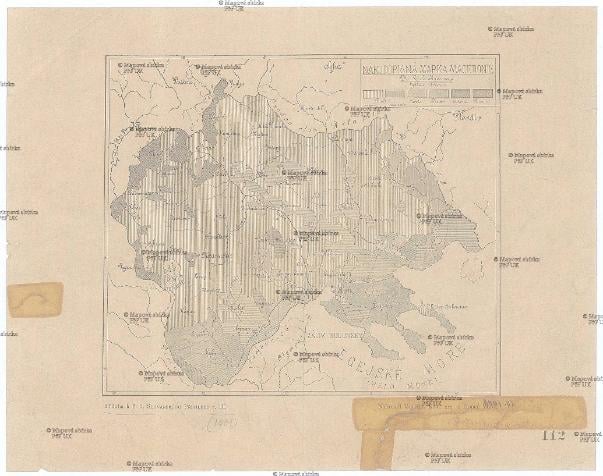
This map shows the geographic, ethnic, and linguistic region of Macedonia – a fact that has been recognized by everyone at all times, except in the last century or so, when it was purposely obfuscated, as a consequence of the geo-strategic and political interests of the neighboring countries, and the great powers that have supported their policies ever since the end of the Ottoman Empire.
The Macedonian Question was seemingly ‘solved’ with the separation of Macedonia in 1913 between Greece, Bulgaria, Serbia (the Kingdom of Yugoslavia after WW1), but was once again brought to the surface with the recognition of the Macedonian people, as a distinct nation, by the Communist Party of Yugoslavia, which was in need of manpower for the ongoing revolution.
Although the Yugoslavian national identity was superimposed in the Socialist Federal Republic of Yugoslavia, Macedonians, just like the other nations within the federation, enjoyed all rights and liberties of being who they are, which was not the case with the Macedonians living in the neighboring countries, and it is still not the case! For instance, Macedonians in Greece are called Slavophone Greeks, and in Bulgaria, they are not allowed to establish their own associations and cherish their own language, tradition, and culture.
Now, the biggest problem emerged when Yugoslavia dissolved, and the part of Macedonia that was once occupied by the Kingdom of Yugoslavia, and then liberated by its own people, and enjoyed its freedom and peace in a federation with the others, was now an independent nation within the federation!
Just as Yugoslavian was a superimposed national identity to many different peoples, in the same way, the Greek and the Bulgarian national identities have been superimposed over various ethnic groups. The only difference is that the ethnic groups who lived within Yugoslavia enjoyed full recognition of their right to belonging, while the ethnic groups within the other countries had to go through the nation-building processes imposed by their national governments, which were often trying to impose the national identity using Draconian measures. It would be politically correct to say that there has been a serious process of assimilation, and serious violations of human rights, which does not seem to be coming to an end!
Both Greece and Bulgaria, now members of the EU, recognize only religious and linguistic minorities, for them, there are no ethnic groups different than the national. Both have committed serious crimes against humanity in order to instill and maintain the superimposed national identity (population exchanges – Greece dislocated many ethnic Macedonians in Turkey and Bulgaria, and introduced a Greek-speaking population from Asia Minor in the region of Macedonia, later on, the exodus of the innocent population during the Civil War, the change of toponyms and personal names, the political prisoners, both fighting on the side of the Nazis during WW2 etc.) and are further denying the basic human rights to belonging for the ethnic Macedonians who have existed on the territory of Macedonia ever since…
The very existence of Macedonia and Macedonians, for these two countries, undermines all of their nation-building efforts from the previous century, and reveals all atrocities committed in the process! It poses a threat of dissolving their national cohesiveness, which can have serious consequences within their societies, or so they fear. Moreover, it will reveal serious fabrications and frauds committed by third parties, mostly international stakeholders, who have imposed a distorted worldview and have consciously concealed valuable finds to the disadvantage of science, and to the catastrophe of the Macedonian people, as well as the instability of the Balkans as a whole.
The Macedonian Question once resolved, the Balkans will see peace! And the only way to solve this issue is to recognize the truth! And the truth is that we are all human beings and we all have rights! The right to belonging to a national, ethnic, linguistic, cultural group of your own choice and preference is a guaranteed right! It’s the right to identity! Isn’t it? How can then changing my name and identity be a condition for my country to join the ‘more democratic’ EU? How can I accept that as a progressive solution?!
I say I belong to Macedonia, I am Macedonian! It is my own right! You can call the state whatever you like, this is my identity, both ethnic, regional, linguistic, and cultural!
We can discuss the various historical influences and developments, but the fact is that there is a distinct ethnic, linguistic, and regional Macedonian identity that is undeniably witnessed by its rich cultural heritage, both tangible and intangible. Macedonia has a story to tell to the world!
Is the world ready to listen?
#EuropeanUnion#EuroepeanCommission#Macedonia#Bulgaria#Greece#MacedonianQuestion#FRSA#UN#CulturalHeritage#UNESCO
Description: Makedonie
Creator: Král z Dobré Vody, Vojtěch
Contibutor: Kančov, Vasil, 1901
via @PeroSardzoski








 in _d @Potru's wor(L)d